





|
Best when viewed with Firefox
Don't use standards- noncompliant products like IE. |









What's New...
July 16 2023: Since Tim Keller, pastor of the start-up Redeemer Presbyterian megachurch in Manhattan and co-founder of The Gospel Coalition, died earlier this year, I have read the recent biography by Collin Hansen. My thoughts here.
July 4 2023: Another one bites the dust: Don Lancaster.
I've subscribed to hobby electronics mags most of my life, and Don had a column in Popular Electroncs. He always had interesting ideas and techy suggestions, but he had a pithy, no-nonsense attitude that would have drawn your attention regardless of what he was saying. I was particularly taken by his position on patents: Bad idea. Don't bother with them. Time-to-market and constant innovation are the real values.
Done now. But apparently someone has taken over his Guru's Lair website. I hope it sticks around.
. . . . . . . . . . . . . . . .
I've just learned that All Electronics is going out of business ("Nauooooah, Nooauhhuoo"). I've cleaned up my electronics pages and replaced a bunch of single-board computers that I'm probably not ever going to mess with, with the Agon Light and PicoMite computers that I am playing with.
March 21 2023: One of the fun things about the TI-99/4A is that you don't need anything other than the console to play with it. Turn it on, and it's in TI-BASIC. I'm sure most or all of the home computers of the day were instant-on boot-to-BASIC.
There seems to be a resurgence of retrocomputing at this time, with new hobby-designed machines being introduced all the time. There's also a lot of simulators (such as MAME and Classic99) and emulators that run in FPGAs (such as MiSTer), but for many, such as myself, there's no real substitute for the actual hardware. Which is fairly impossible for TMS9900. But not for Z80 family members, or 6502 family members, and not for new stuff like the Raspberry Pi's RP2040.
One of the most serious problems with retrocomputing is the display. It's hard to find composite monitors now, and generating composite video is no cakewalk. The old computers had dedicated graphics devices which are largely unavailable. An interesting trend is the generation of VGA video directly by using fast processors.
Being who and what I am, I've come across two boot-to-BASIC small computers that I could not resist trying out.
#1: PicoMite VGA
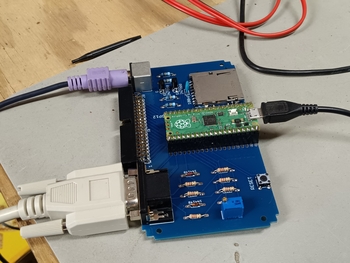 When I came across the PicoMite VGA on Geoff Graham's site, I was hooked. It uses a Raspberry Pi Pico, a tiny board with their RP2040 microcontroller that costs $4! Irresistable! Well, I've got a few of those (of course). The circuit board is very simple and easy to reimplement and is entirely through-hole (except for the optional SD Card holder). Geoff is an Australian, and the equivalent there for Nuts & Volts is Silicon Chip, and I was pleased to discover that they offer circuit boards for the more popular projects, including the PicoMite VGA, which they have available for $5. Of course, it takes a bit more than that to have it mailed from Australia.
The PCB Construction Pack available on Geoff's site contains four designs, of which the simplest and the one most commonly presented is #1. The folder contains a set of Gerber files for having a PCB fabricator make the board, but even the low-cost DigiKey PCB Builder service costs more than that (and you can't just get one or two). Furthermore, when I uploaded the Gerbers for an estimate, it complained that the project lacked an Outline file. So I would be back to laying it out again in gEDA PCB. I took the easy way of getting pre-made boards from Australia.
The kit also contains an assembly guide with a parts list. If I had been careful, I could have found equivalents for these easily-found parts at Mouser or DigiKey, but again I took the easy way and just searched for the listed parts. Turns out Newark distributes Element14 in the States, and all these parts were in their catalog except that the connectors and some other bits actually had Farnell numbers (Newark is the US partner for Farnell), so some of these things came from England. A very international project! At the end, the parts were the majority share of the cost of this little project. The one surprise was that the trimming potentiometer comes in two flavors, in-line or staggered pins. The board uses the in-line pins version, and in my ignorance I bought the staggered version. Fortunately, the 200-ohm 64W trimmer with in-line leads was available out our own Elliott Electronics.
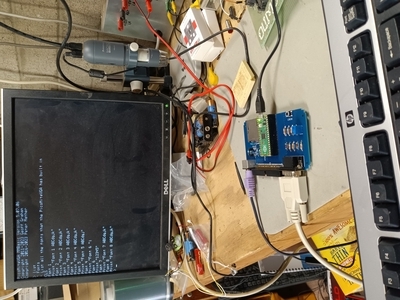 Assembling was a quick job of an hour. One of the Really Cool Things about the Pico and the RP2040 is it has on-chip USB and a Bootloader that presents itself as a flash drive. Copy the binary to the flash drive and it's programmed! The PicoMiteVGA firmware is available from Geoff's site, and in less time than it takes to tell, I had a power-up banner and a prompt on my VGA monitor!
The PicoMiteVGA boots directly into MMBASIC, which was originally developed for it's big brother, the MaxiMite. It seems the MaxiMite became a very popular gadget (Silicon Chip has a fair number of PCBs and kits for sale), and there are a lot of MMBASIC resources. The PicoMiteVGA User Manual from Geoff's site includes a tutorial and a guide to the commands in the PicoMite port of MMBASIC - it's a very powerful BASIC that includes built-in GPIO, I2C, SPI, talking to an LCD module, array math, quaternions (I guess you can connect a solid-state IMU to the PicoMite and write a navigator in MMBASIC), and so very much more. Impressive, really.
The best part of this project is how it makes a great many of the Pico's I/O pins (in fact, all that are not already being used for VGA and SD Card purposes) available on the 40-pin header. The PicoMite project calls for a vertical header, but I chose a shrouded right-angle header. I haven't had much of a chance to play with this yet.
Turns out that after loading the program, the USB behavior changes from being a flash drive to a serial port. With a terminal, commands can be sent over the serial port instead of (or in addition to) the keyboard. Furthermore, the SD Card is optional. It would of course be more convenient to put programs and other files on the PicoMite by copying them to the card from a regular computer, but the PicoMite also allocates part of its internal flash memory as a drive. When you enter programs from the keyboard, you can save them to a file directly (in fact, the program is written to flash from the keyboard and remains there, ready for use, through power cycles). You can also transfer files from a host computer to the PicoMite's internal drive via XMODEM over the serial link. That was a blast from the past!
#2: Agon Light
Bernardo Kastrup, aka Byte Attic, was formerly an engineer and then a manager with several Silicon Valley computer companies. When he retired (comfortably, I imagine), he chose to use his spare time designing small computers. He has quite the menagerie, but the most recent - and most successful and popular - is the Agon Light. Partnered with Dean Belfield and Jeroen Venema, they designed a modern 8-bit computer with currently available parts that would use no FPGAs or simulators - the processor would be an authentic really-truly 8-bit processor - and no legacy silicon such as graphics controllers. Low cost and open-source are also design constraints. What they produced is the Agon Light, a small board with an eZ80F92 microcontroller (yes, Zilog still makes Z80 items and has several Z80-based microcontrollers) as the main processor and an ESP32-PICO-D4 module acting as the "terminal"; that is, it generates VGA video, audio, and interfaces with the keyboard, and communicates with the main processor via a fast serial link. Very reminiscent of 70s and 80s small computer systems.
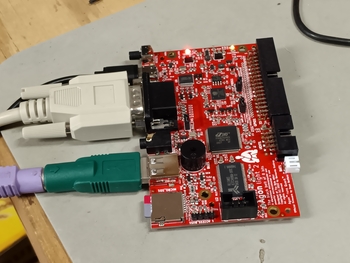 It's open-source, so Byte Attic doesn't produce or sell them, so you can either pull down the design materials and get a board maker to fab a board and then assemble the parts, or take the easy way and find someone who has already done that. PCBWay in Red China has done this. Olimex has modified the design slightly (the beauty of open-source) and provides a lower-cost unit. I've used Olimex stuff before, so I was comfortable in ordering an Agon Light 2 - even though it turns out it comes from Bulgaria.
The weird thing about Olimex' Agon Light 2 is that it uses a USB "A" connector for the PS/2 keyboard. Apparently in the early days, more computers had PS/2 keyboard and mouse ports than USB ports, so keyboards that had USB capability had fall-back PS/2 function; that is, they were dual USB and PS/2. Not so true anymore. So if you can't find a dual-function keyboard, you get a PS/2 (there's still lots about, including a two bins full at Elliott Electronics Surplus - a truly wizard place, right here in Tucson) and a passive adapter such as the AD-UP3. I also found that the dual-function keyboards are still being made, such as the KU200US by V7, which is available from many sources including Walmart.
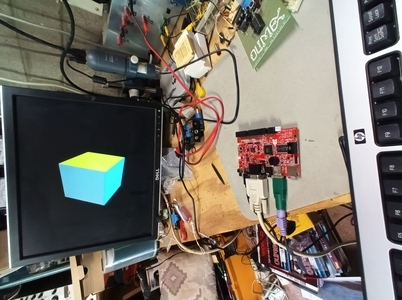 Unlike the PicoMite, the Agon Light boots (almost instantly) into a rudimentary operating system, MOS. Programs can be loaded and run from the MOS prompt, and the most common is the Z80 port of the legendary BBC BASIC. It seems there is also a CP/M port, and some people have got FORTH to run on the Agon Light. MOS recognizes something akin to AUTOEXEC.BAT so it can run a program at boot, and the stock SD Card file set loads BBC BASIC. I believe it is also possible to auto-run a BASIC program. There are free Z80 tools - assemblers and C compilers - so programs can be developed for the Agon Light in somthing more speedy than BASIC, but BBC BASIC is no slouch - the Byte Attic website has some benchmarks in which the Agon Light beats all contenders running BASIC programs. BBC BASIC is not quite as amazingly fully-featured as MMBASIC, but like MMBASIC it has GPIO commands.
The Agon Light is fixed to be a microcontroller as well as a microcomputer, and there's a 32-pin header providing access to several GPIO and some mixed function I/O. The Agon Light 2 modifies this a bit to add a few signals, so the connectors are not quite compatible. Agon Light 2 also adds a UEXT connector, which really just duplicates connections to some of the main port pins to another connector that allows attachment of UEXT peripherals. Apparently, Seeed Studio has "Grove", Sparkfun has "Qwiic", MIKROE has "Click", and Olimex has "UEXT".
The "terminal" program running on the ESP32 is built around FabGL and drives the VGA signals directly. The Video Display Processor (VDP) is built under Arduino for the ESP32. It is capable of several display modes, handles different fonts, and can even generate sprites. The stock demo programs, such as CUBE.BBC seen running above, show off the abilities and speed of Agon Light's video features. The VDP also handles the PS/2 keyboard and audio, but I have not yet got audio to work; I think I need a VDP update.
And that is perhaps the best thing about Agon Light: it is still under active development, and apparently very popular. Dean is working on MOS 1.03 and VDP 1.03 with imminent release. PCBWay and Olimex can't keep up with demand, not to mention the groups of hobbyists pooling to have PCB orders done. The primary forum for Agon Light is on Facebook, and it is very active.
While the Agon Light is primarily intended to be a boot-to-BASIC microcomputer, it certainly can be programmed in other languages, such as Assembly and C. BBC BASIC for Z80 has a built-in assembler, and Venema has produced a more traditional native assembler. Looking at the Z80 instructions (such as in this now-public-domain Zaks/Sybex "How To" book), it might be fun to play with that. Zilog has their Zilog Developer Studio II available for free; it's a cross-assembler and cross-compiler that runs under Windows (or WINE). I suspect that it's only a matter of time before Belfield or Venema or someone else ports ANSI C to run natively on the Agon Light. I also believe it won't be long before Python (especially MicroPython (already available for the Raspberry Pi Pico, if not natively for PicoMiteVGA) or CircuitPython) will show up on the Agon Light.
February 28 2023: A lot going on next month. Tucson Festival of Books this weekend. Tucson Garden Railway Society Tour the weekend after that. And Davis-Monthan Air Show at the end of the month.
 Before the Covidiocy, there was a plan for D-M and Luke in Phoenix to trade years, but there's nothing about that now. In fact, even though there's nothing on the Luke AFB site about it, there's a suggestion of a show at Luke AFB. Also this month. I wouldn't mind taking in a show at Luke, but I'll probably stick with a sure thing at D-M.
January 9 2023: A few months ago, I caved and bought an expensive kit to build a 60% scale PDP-11 replica: the PiDP-11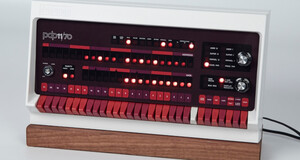 . It was designed to use a Raspberry Pi running SIMH. However, the developer, Oscar Vermeulen, indicates that it is possible to use a FPGA module to emulate the PDP-11 in hardware.
This separate project uses a 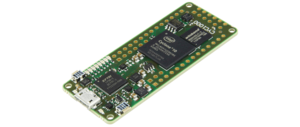 CYC1000 module, which has an Intel/Altera Cyclone 10 FPGA with 25K logic elements and a nice USB programming port. And the development tools are free. And appear to run under Linux. What a fun toy!
I would much prefer to have a PDP-11 running as an emulation than as a simulation with boring old ARM instructions actually being executed. It's the next best thing to having a LSI-11 executing actual PDP-11 instructions.
Unfortunately, it seems that the demand for semiconductors that so hugely outstrips the present supply has made the CYC1000 unavailable. In discussions with the Arrow tech rep, it seems there is a 26-week lead time. He tells me that FPGAs are so dear that people were (are?) buying dev kits and removing the chips. But he assures me that the CYC1000 design is still viable, and I should be able to get on the 26-week waiting list. He is also going to look around for other FPGA modules that
- Have at least 25K logic elements
- Are programmable using free vendor-provided tools (hopfully that will run under Linux)
- Have a module pinout like the CYC1000's MKR-compatible pinout that I could make a Raspberry Pi footprint adapter
- Not so big that it won't fit in the available space in the PiDP-11's housing
I'm thinking that even if he finds some, they won't be any more available than the CYC1000, for the same reason.
So maybe I'll build the PiDP-11 I've already bought and received with one of my Raspberry Pi units and get SIMH running and put RT-11 or BSD Unix on it while I'm waiting for the ice to break on the Intel FPGA dam.
. . . . . . . . . . . . . . . .
Someone else has put a CYC1000 in a PiDP-11
December 10 2022: I got a notice from Digikey for a "training" (marketing) on-line lecture for the Arduino Portenta X8. I've got a few Arduinos, and we've used them in integration equipment, but I'd always thought of Arduinos as relativey cheap, limited, not really professional products, but "Portenta"... it was worth signing up for a one-hour video lecture by the Italian product manager.
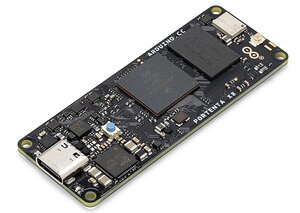 It's a grown-up Arduino. Seems Arduino has multiple divisions, and what we're all familiar with is the low-end "Classic" series (UNO and the Mega and such). Seems there is a relatively new MKR series with a ARM Cortex-M0 (SAMD21). The big thing about the "Classic" boards is the more-or-less consistent expansion connectors (stackable headers), mimicked by many other vendors in order to share in the Arduino "shield" ecosystem. The MKR departs from this standard. But Arduino has a "Pro" division, and the Portenta X8 is the flagship. It doesn't have stackable headers at all, but two high-density mezzanine-style connectors on the back. The Portenta X8 has a NXP main quad-core microprocessor and a ST dual-core microcontroller, and oodles of I/O and peripheral power. The main port is USB-C. It runs a Yocto embedded Linux, and the applications run in Docker containers. It's targeted at the IoT market (what isn't, anymore) and so WiFi and Bluetooth are built in. Arduino is getting into the IoT world and has their own Cloud service (of course).
Pretty cool. Like a hopped-up Beagleboard. The connectors are a bit of a letdown; to get anything off, you have to have a carrier or breakout board (which Arduino has). The big downer is price: $239. And the breakout board is another $55. Interesting, but that's a pricey toy.
The Arduino "Pro" family also has the Portenta H7 with a dual-core ST microcontroller. Not Linux-capable, but more powerful than a Cortext-M0. It has a MKR-compatible stackable-header feature and also the Portenta high-density connectors on the back. So it's essentially a crossover. It's $114.
So... interesting, but I think I'll skip the Arduino Pro line for now. I might look into the MKR series, which actually has a growing portfolio of shields (and there's a MKR2UNO transition shield to allow the use of "Classic" shields). A basic MKR WiFi 1010 with Wifi and Bluetooth is around $40. That's more manageable.
. . . . . . . . . . . . . . . .
While poking around DigiKey, I discovered that they are carrying the Seeed Studio XIAO devices, such as the SAMD21, RP2040, ESP32-C3, and nRF52840 based tiny computers. That use Seeed's interface and are not obviously reprogrammable. Still... $6...
September 22 2022: I've started a new project at work for Bluetooth Low Energy (BLE) that uses a Fanstel BT840 module based on the Nordic nRF52840 device. I'd done a nRF52832 project maybe a year ago, got familiar with Nordic's Software Development Kit (SDK), and was expecting to reuse some code from that project. Lo and behold, Nordic has completely revamped their SDK to make the Zephyr Real Time Operating System (RTOS) the central feature. Can't reuse any code from old projects. But after going through the tutorial and seeing how I can pick and choose features from the Zephyr library, it's not so bad. Better in many ways than the mish-mash that the older Nordic SDK was.
About the same time, I had signed up for a Digi-Key on-line training event about "Embedded Systems". It was a brief thing, but I got a Digikey link to an "official" ARM education course on developing for ARM hardware. Digikey of course has a kit for the lab exercises based on the STM32 Cortex-M4 device. The course features the Mbed RTOS which is the "official" RTOS of the ARM organization.
Also about the same time, I signed up for Silicon Labs "Works With" conference, looked at their interesting BGM21/22/24 families, their development system (Simplicity Studio) can run under Linux, and it seems they officially support Mbed OS. At least, that's what I picked up in some lecture I watched (on-demand; I could not participate in the sessions as they happened during the working day). When I go to the Silicon Labs site and search for mBed or RTOS, I get a bit about mBed. On the other hand, when I look at Resources -> RTOS, I see "FreeRTOS" (that's good), "Amazon FreeRTOS", "Micrium OS", and "Asure RTOS", but nothing about Mbed. If Mbed is the "official" ARM RTOS, I'm a bit surprised they don't emphasize it more.
Mbed is just one of many RTOSes that are targetted at ARM. Besides Zephyr and the ones that Silicon Labs support:
- Zephyr
- Mbed
- The venerable FreeRTOS
- The even more venerable uC/OS-II (and III). uC/OS had kind of a spotty history as a free or open-source OS; it's under an Apache license now but "owned" by Weston Embedded. Micrium, former owner of uC/OS, was acquired by Silicon Labs (hence one of the several RTOSes supported by them).
- Contiki, for "resource-constrained" platforms (such as AVR and MSP430)
There are lots more (presumably the list on Wikipedia will be kept current); these are the ones that are most interesting to me at this time.
. . . . . . . . . . . . . . . .
The labs at the conference, at least the MAT-301 "Design for Matter with the MG24" (the EFR32MG24 is perhaps the most interesting device, as it seems to support all the RF protocols except WiFi) have hardware requirements, which apparently got shipped gratis to people who registered far enough in advance. The components for the lab include a Raspberry Pi 4 (fair enough, except they're out of stock everywhere) and two radio modules. The lab manual specify the BRD2703A or the EFR32MG21 USB Stick, but says that the BRD4186C or BRD4187C can be used. The "hardware requirements" document in the lib Github repository includes a bunch of MG12 boards (not so interesting), explicitly states that the BRD2703A is not yet available (the USB stick gadget is apparently not available yet either), and mentions the xG24-DK2601B, which is available (for $79 at Digi-Key and Mouser).
The radio modules must be used with a WSTK mainboard such as the SLWSTK6006A. But the SLWSTK6006A is a "starter kit", includes THREE WSKT mainboards and a number of BGM21 modules (I don't want BGM21 modules) - For $479. Owie-ow-ow. There doesn't seem to be a way to get just a mainboard. Maybe the mainboard in the Pro Kit is the same as the WSTK, but it doesn't say (no part numbers). The User Guide says the radio board plugs into the Wireless Starter Kit Mainboard (BRD4001A) or the Wireless Pro Kit Mainboard (BRD4002A). So they're not the same. The User Guide also says that the drawings, including the schemos, are available on the "kit page" on the main site page, but there is no such thing. Oh, wait, silabs.com -> Resources -> Technical Library -> Schematics and Layout Files; search for "WSTK" and there's the BRD400A and BRD4002A. Looking at the schemos, no, they're not the same, but they may be close enough for the lab. BRD4002A is more complex and has an analog joystick and a USB-C connector, versus BRD4001A that has a USB mini-B connector.
The $79 xG24-DK2601B is based on a EFR32MG24 chip, but all the devices listed on the EFR32MG24 page list only the $179 Pro Kit as a dev kit.
Let's just say I'm not thrilled by the quality or consistency of Silicon Lab's website.
So what is so special about this MG24 dev kit that it's so pricey?
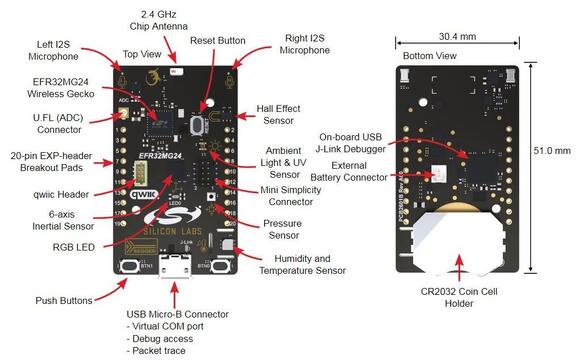
Wow. Two microphones. An IMU. Light, pressure, temperature, and humidity sensors. Even a Hall-effect sensor. What a busy board! Lots of playing with this one!
(The class using the STM32 eval board is pretty interesting, but I'm already wound up with the ESP32 things which I already have, and I need to learn another dev system like I need a hole in my head. However... I notice there are some wireless STM32 devices that support BLE 5.2 and WiFi and Thread and Zigbee, just like the SiLab MG24...)
September 5 2022: This past weekend was the Tucson ComiCon. They've been shut down for the Wuhan virus panic for the last two years, so this year was a restart. I think it showed in the sort of guests that came and the paucity of panel topics.
We came for all three days, and were exposed to unexpected implications of the Convention Center:
- Parking is insufficient. There was a ridiculous line from Granada trying to get to the southwest surface lot. I took Jerri in that way to drop her off at the main lobby but was unable to merge into the line for the lot, so I went back out. There is a new parking garage behind the Music Hall, but it was apparently already full and blocked off. There is also a new parking structure on the northwest corner next to the hotel. There was a long line for that one, too. I'm not sure that the parking structure added as many spots as were lost to the new hotel and traffic routing. Plus, the cathedral across the street was selling parking spots. Everything was full. I guess this indicates how popular the ComiCon was, and that's a good thing (seems the Sugar Skulls were playing at the TCC on Sunday, not sure how much parking demand was due to their game). So I had to park at some distance away and walk over.
- TCC management has new burdensome "security" restrictions. Only transparent bags and backpacks. Purses have to be of the small sort. We didn't know all this before arriving, so I had to walk all the way back to where I parked the car with Jerri's now-illegal purse. But no metal detectors. No inspecting costumes (beyond the usual "peace bonding" for verifying prop guns are not real). I don't know how the TCC management has convinced themselves that these "precautions" are going to prevent even mildly determined assailants. Mosty, they just make things difficult for legit attendees.
At any rate, the Con was lightly attended on Friday but Saturday and Sunday were flooded. Nice to see. Lots of cosplayers. But I missed the "steampunk" panel on Friday while I was walking the purse back to the car (and Jerri told me later that there was no "steampunk" panel on the boards of any of the (six) panel rooms, so they must have cancelled it). None of the other panels or spotlights were interesting - except one.
 Jim Shooter started in comics at age 13, and at mid-70s he's still at it. He was Editor-in-Chief at Marvel in the late 70s when the comic industry was imploding, and managed to turn Marvel Comics around and into the powerhouse it is today. Of course, I didn't know any of this until the interesting septuagenarian was telling his story at the spotlight. We went back the following day for the "History of Marvel" panel. Yes, mostly his recollections of his time at Marvel (but like he says, his presence there overlaps with most of this history of Marvel), but he explained how the comic book industry was born from the collapse of the newspaper comic strip phenomenon in the '50s, and how Stan Lee, Jack Kirby, and Steve Ditko were instrumental in the early days of Marvel Comics. It was so impressive how good his memory was of the artists, editors, and managers of the comic industry in the "Bronze Age". It was also illuminating when he explained how clueless Marvel executives were, and how frequently he was called "upstairs" to advise people who had "never opened a comic book".
jimshooter.com. Not kept up to date, but there's a wealth of insight, history, art theory, and opinion by a comic industry titan.
Well worth the admission to ComiCon.
. . . . . . . . . . . . . . . .
Another one bites the dust:
 Bill Johnson was a radio personality in Phoenix in the fabulous '50s (some background here). Part of his legacy was a small local chain of "Big Apple" steakhouses. The original was on Van Buren Street, quite a ways east of downtown, and we dined there maybe twice after the others had closed and the writing was on the wall for the last one. It was in a scary industrial area and only lightly patronized, so it was no surprise when it closed.
 Then I happened to notice "Bill Johonson's BBQ Sauce" on the shelf at Fry's. I switched over and got to enjoy the last relic of an Arizona legend. And it was pretty decent sauce.
But I was buying sauce a few weeks ago and it wasn't on the shelf. Not even a spot for it. I checked at Albertson's and Safeway; similarly absent. A hint on some site after a web-search suggests that the family has decided to discontinue it.
 How sad. Back to Big Bob Gibson's Award-Winning BBQ Sauce (from Decatur, Alabama).